
Your Guide to Employee Feedback and Strong Teams 2026
Looking for ways to strengthen your team through effective employee feedback? Our guide presents models, examples & tips, even for mobile teams.
After a long event, you know the situation. The guests have left, the shift is done, and the first questions about next week are already popping up in the team chat. Two people performed exceptionally well, one person was late again, and something was missed during the handover to the night shift. If you say nothing now, the pattern will repeat. If you address it clumsily, you risk losing exactly the people you need for the next assignment.
Especially in mobile, flexible teams, employee feedback is not a nice extra. It is daily leadership work. In events, gastronomy, security, or healthcare services, what counts is not what is said once a year in the meeting room. What counts is what is communicated and understood shortly after the shift, after a sensitive situation, or after a strong performance.
Meta description: Learn how to build employee feedback in mobile teams so that it works in daily shift operations, remains data protection compliant, and encourages good people to come back.
Table of Contents
- Why Employee Feedback Is Crucial Right Now
- What Good Employee Feedback Looks Like
- Proven Feedback Models at a Glance
- Concrete Examples of Feedback Conversations
- Frequency and Timing in Shift Operations
- Feedback for Mobile Teams and Special Industries
- Measuring Success and Staying GDPR-Compliant
Why Employee Feedback Is Crucial Right Now
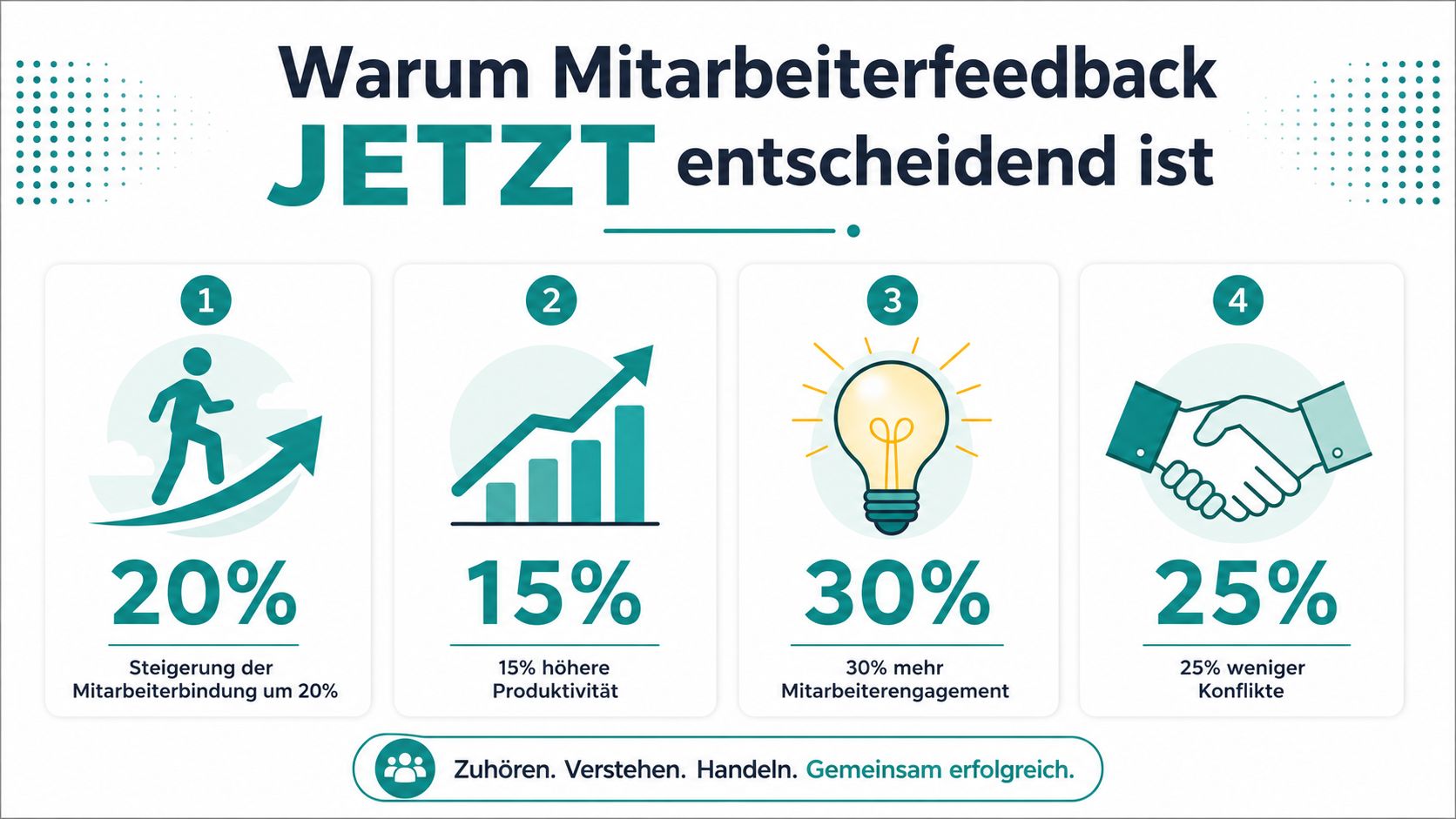
After a big trade fair weekend, it quickly becomes clear whether a team just works shifts or actually learns. Entry ran calmly under pressure, one service staff member covered a failure strongly, but two important pieces of information were lost during the handover in the late shift. If such points are not properly fed back anywhere, the next assignment starts with the same strengths blindly and the same mistakes in tow.
That is exactly why feedback belongs in shift operations. Those who record good performance immediately can schedule reliable people more precisely. Those who address problems concretely reduce the risk that they will recur at another location or the next night. In mobile daily work, this is not an additional task for sometime later. It is part of keeping teams operational.
What Missing Feedback Triggers in Operations
In flexible teams, the consequences are often visible after just a few shifts.
- Good people remain invisible in the system. Those who always deliver but never receive clear feedback quickly feel like interchangeable reserves.
- Errors get passed on. Incomplete handovers, late sick notifications, or poor radio discipline then don’t just appear once, but thrice.
- Leadership seems random. If reactions only happen in anger, the team doesn’t know what performance is measured against.
- Replacements take more time. You have to check more carefully who you can rebook because reliable feedback from assignments is missing.
Practical rule: What is not named after the shift, you will have to correct later with more effort.
This point is already relevant in the office. In events, gastronomy, and security, it is even tougher. Teams change, locations change, contacts change as well. Many employees see their shift leader only briefly at briefing and maybe again during teardown. Without a fixed feedback process, often only memory, mood, and hearsay remain. That is not enough if you want to reliably schedule personnel for demanding situations.
That is why fixed annual reviews in these industries only work as a supplement. Crucial is the short, usable feedback directly after the assignment or at the latest on the same day. Two sentences can be enough if they are concrete. Even better if the feedback is documented in an app so it doesn’t get lost in chat histories or in the heads of individual shift leaders for the next assignment.
Why This Is Especially Impactful in Shift Teams
Mobile teams don’t need feedback because of an HR ideal, but because of the rhythm of their work. Someone working at a fair today might be at a stadium tomorrow or take on a gastronomy assignment with a new crew. Leadership through daily proximity is therefore not possible. Leadership must happen through clear standards, quick feedback, and clean documentation.
I would put it this way: Without feedback, you schedule personnel only by availability. With feedback, you schedule by reliability.
This is exactly where workforce management technology helps. When foremen or shift leaders record praise, notes, and short evaluations directly in the app, a reliable picture emerges from many individual shifts. This saves follow-up questions, makes decisions on rebooking cleaner, and helps new team leaders not have to assess people from scratch. The effect is just as noticeable for employees. They see more clearly what is expected of them, what went well, and what they should work on for the next assignment.
What Good Employee Feedback Looks Like
Many team leaders mean well and simply say after the shift: “Well done.” That sounds friendly but achieves little. The person doesn’t know what to repeat. Equally weak is a sentence like: “That was unprofessional today.” The frustration comes across, but no clear next step.
Good employee feedback is like a clean operational note. It describes what happened, how you recognize it, and what should follow. Not vague, not personal, not two weeks later.

Four Rules for Useful Feedback
The simplest analogy is this: Praise without content is like a shift plan without a time. Criticism without observation is like a complaint without an incident.
- Say what you saw. Not “You are committed,” but “You independently reorganized the queue at the entrance when two scanners failed.”
- Describe the impact. Not “That was great,” but “This kept the entry calm and guests didn’t get impatient.”
- Make the next step clear. Not “Please pay more attention,” but “Report delays directly before the shift starts in the chat or app.”
- Separate behavior from person. “The handover was incomplete” is useful. “You are unreliable” hits the person and blocks any conversation.
A short example from gastronomy: A shift leader says after service to a runner: “Thanks for your effort.” Nice, but empty. Better is: “When three tables were open simultaneously in the second block, you replenished cutlery and water without being asked. This kept the service flow calm. Please do the same tomorrow.”
Good feedback is not soft. It is clear enough that someone can act differently or the same tomorrow.
Those who feel unsure before conversations can remember this short classification:
| Type of Feedback | Often sounds like | Effect |
|---|---|---|
| Praise | “Great job” | nice but often too vague |
| Criticism | “That’s not how it’s done” | creates pressure but rarely direction |
| Constructive Feedback | “You did X. That caused Y. Next time please do Z.” | understandable and useful |
A Quick Checklist Before Every Conversation
Before you address something, check these points in one minute:
- Is the occasion concrete enough? A single incident, an observed action, a clearly recognizable strength.
- Can the person make sense of it? If not, rephrase.
- Is the tone factual? Especially after stressful shifts, better to cool down briefly.
- Does the conversation benefit the next assignment? If it only vents steam, skip it.
Many leaders also need a spoken example before they find their style. This video explanation shows well how constructive feedback can be structured in conversation:
Proven Feedback Models at a Glance
In everyday life, you don’t need complicated theory. You need a form that works under time pressure. Three models repeatedly appear in practice. Not all fit equally well for mobile teams, short shifts, and changing locations.
SBI for Everyday Use
The SBI model stands for Situation, Behavior, Impact. It is usually the most useful form in shift operations because it goes directly to the observed situation.
Example from security service:
- Situation: “At the handover at 10 p.m. at the side entrance.”
- Behavior: “You did not record the special access in the handover log.”
- Impact: “The night shift had to call back and had no clear status.”
Short, factual, without character judgment. That is exactly why SBI is suitable for praise as well as sensitive topics.
Sandwich Technique with Caution
The sandwich technique often structures feedback like this: first something positive, then criticism, then something positive again. This can help if someone is very tense or has little conversation routine.
In everyday life, it often fails due to one problem. Employees quickly notice that the first praise is only an introduction to the unpleasant part. Then real praise loses value. In event operations, I often hear sentences like: “You were very friendly to the guests, but…” After the third time, everyone knows what’s coming.
If every praise sounds like a prelude to criticism, soon no one listens properly to praise anymore.
360-Degree Feedback for Larger Development Topics
360-degree feedback collects feedback from multiple perspectives, such as supervisors, colleagues, or project partners. For daily business and spontaneous shift corrections, it is usually too cumbersome. For roles with leadership responsibility or longer development questions, it can be useful.
An example from a venue organization: The head usher receives feedback from the operations manager, other team leaders, and his crew. This makes it visible whether problems occurred only in a single shift or if a pattern runs through. For a day worker on a single assignment, that would clearly be too much.
Comparison of Feedback Models
| Model | Best suited for | Advantage | Disadvantage |
|---|---|---|---|
| SBI | quick shift feedback, praise after concrete situations, short corrections | clear, direct, easy to learn | requires precise observation |
| Sandwich Technique | sensitive one-on-one talks, when resistance is expected | seems gentle at first glance | can seem insincere or predictable |
| 360-Degree Feedback | development talks, leadership roles, longer collaboration | multiple perspectives instead of single opinion | requires more coordination and discipline |
For mobile teams, the recommendation is clear. Use SBI first in everyday life. It fits radio, back office, night shift, and short voice messages equally well. Keep sandwich as a backup form in mind. Save 360-degree for people who are permanently responsible.
Concrete Examples of Feedback Conversations
Models only help if you can express them. Therefore, here are no theoretical statements but real formulations from everyday work. All examples roughly follow the SBI structure. The shorter and clearer, the better.
Praise After a Stressful Shift
This sounds good:
Team Leader: “At entry shortly before the concert started, the scanner on lane two failed. You immediately redirected people to the other lane and calmly informed the guests in parallel. This prevented a queue in the foyer. This quick thinking is exactly what I need in such moments.”
Not like this:
Team Leader: “Yeah, it was good today.”
The problem is not the tone. The problem is the emptiness. The person doesn’t know which action was meant.
Late for Shift
This sounds good:
Shift Leader: “You were not at the meeting point at shift start today but arrived later on site. Because of this, I had to redistribute tasks at short notice. If you notice it’s tight, please report immediately before the shift starts via message or call. Then I can react before the shift goes off track.”
Not like this:
Shift Leader: “You are always late. You can’t work like that.”
Here, behavior is turned into a label. That makes things unnecessarily harsh and rarely better.
Safety Rule Not Followed
This sounds good:
Site Manager: “During the patrol in the second night phase, you documented the door check but did not perform the counter-check. This is critical because the documentation then does not match the actual check. Please complete the checkpoint fully in the future, even if it seems quiet.”
Not like this:
Site Manager: “You need to be more precise in the security area.”
The second sentence is not entirely wrong but too broad. The person doesn’t know which situation is meant.
When Employees Should Give Feedback Themselves
Feedback does not only flow top-down. Especially with changing assignments, you also need the team’s perspective back. After a shift, you can simply ask: What made your assignment easier today, and what slowed you down? If you are still looking for conversation starters, you will find good formulations in these questions for employee interviews that can also be adapted for short shift debriefs.
A useful mini-routine after the assignment looks like this:
- Ask about the bottleneck in the process. “Where did you lose time today?”
- Ask about a useful detail. “Which information would have helped you before the shift started?”
- Ask about repeatability. “What should we do the same at the next assignment?”
Short dialogues beat long monologues. Three precise questions often bring more than a half-hour unfocused conversation.
Frequency and Timing in Shift Operations
Annual conversations fit fixed office structures. For event crews, float pools, or mobile security services, they are often too late. If you might only see a person again in three weeks, late feedback loses almost all its value.
The simple rule is: Say it while the situation is still fresh. This is exactly what Encore People confirms about the timing of employee feedback: Give immediate feedback, ideally shortly after the observed behavior or performance evaluation, so that the feedback is timely and actionable; this significantly increases effectiveness compared to formal, only annual reviews.
Why Weeks Later Is Almost Always Too Late
Take a hostess who reacted strongly to objections during a product promotion. If you address this directly after the shift, she can recall this behavior at the next assignment. If you only mention it at the end of the month, the moment is gone. The same applies to mistakes. A forgotten feedback rarely improves on its own.
In shift operations, this classification helps:
- Immediately after the incident, if safety, handover, or guest interaction is affected.
- At shift end, if you want to discuss performance, appearance, or cooperation.
- Bundled in a short weekly rhythm, if a pattern emerges and it’s not just a single case.
A Rhythm That Works in Daily Life
What works in practice is not a heavy ritual but a fixed pace. Many shift leaders do well with a mix of short immediate feedback and brief check-ins. For example, a message after the assignment, later a short conversation for recurring assignments.
An example from gastronomy: After the banquet, the shift leader sends two short feedbacks directly from the tablet. One person receives praise for calm guest communication during kitchen delays. Another gets a note to check the supply cart fully before service in the future. Both take little time but stay close to the reality of the shift.
Timing also decides which tool you need. Those who lead mobile teams quickly notice: Feedback must arrive where the work happens. Not only in the office but on the phone between arrival, assignment, and end of day.
Feedback for Mobile Teams and Special Industries
The assignment is over, the crew is already boarding the bus, car, or night tram. Exactly in this window, it is decided whether feedback is still useful. In events, gastronomy, security, or care, often only a few minutes remain for feedback between sign-off, material return, and the next job.
That is why classic formats rarely work reliably here. The shift leader is not at the same location, part of the team works only for one assignment, and many details are lost as operations continue. According to Staffbase on employee feedback, many temporary employees in the Swiss event industry wait too long for feedback. For rehiring, this speed is often decisive.
How App-Based Feedback Really Helps in Operations
In mobile daily work, feedback must be linked to concrete work steps. Otherwise, it remains general and thus ineffective. An app does not solve every leadership problem, but it closes exactly the gap between the assignment location and management.
In practice, a useful process looks like this:
- The shift is ended in the app. Immediately after, a short form with a few mandatory fields opens for the shift leader, for example punctuality, guest appearance, briefing adherence, and handover quality.
- Special situations are marked directly at the assignment. For example: “Handover incomplete,” “Radio missing,” “On-site briefing started too late,” or “Guest complaint calmly resolved.”
- The feedback goes to the person concerned on the same day. Short enough for the phone, concrete enough for the next assignment. Example: “Stayed calm and escalated correctly at entry. Next time confirm flashlight check before opening.”
- Employees give counter-feedback in the same process. They confirm whether the briefing was understandable, whether material was complete, and whether the shift change was cleanly handed over.
- Recurring patterns are collected by dispatch. Then individual criticism becomes a control instrument. If the same location starts three weekends in a row without complete material, the problem is not with individual staff but in preparation.
This is the difference in shift operations. You don’t just evaluate people but also handovers, briefings, material flows, and site organization.
An example from security: After a concert, the team leader reports in the app that post A worked cleanly but the handover to the night shift was documented without a complete bag check. The affected person immediately receives brief feedback. At the same time, the system sends an internal signal to dispatch because the handover at this location was under time pressure for the second time. Feedback thus becomes not an isolated personnel note but an improvement of the entire process.
For event and temporary teams, it is therefore worth looking at an employee app for events if you want to link feedback directly with shift end, task confirmation, and assignment documentation.
Equally important is the connection to dispatch. Those who plan shifts cleanly, schedule handovers realistically, and don’t push briefings to the last minute also get better feedback back. A useful comparison is the perspective on optimized workforce planning in crafts, because the same basic question arises there: How do you get information to people working on the go in time?
For healthcare services, this connection also becomes visible. Data published in the first quarter of 2026 described a significant decline in turnover in the Swiss healthcare sector after the introduction of feedback apps with very short response times. The exact transfer to events, gastronomy, or security is limited because types of assignments, contract models, and leadership density differ. The practical conclusion remains the same. The closer feedback is to the concrete assignment, the more likely it is to be read, understood, and implemented in the next shift.
Measuring Success and Staying GDPR-Compliant
In the end, a simple question counts in shift operations: Is the next assignment better than the last? Your feedback system must be measured by this. For mobile teams in events, gastronomy, or security, it is not enough to send a mood survey once a quarter. You need metrics close to the shift and rules that secure trust in daily life.
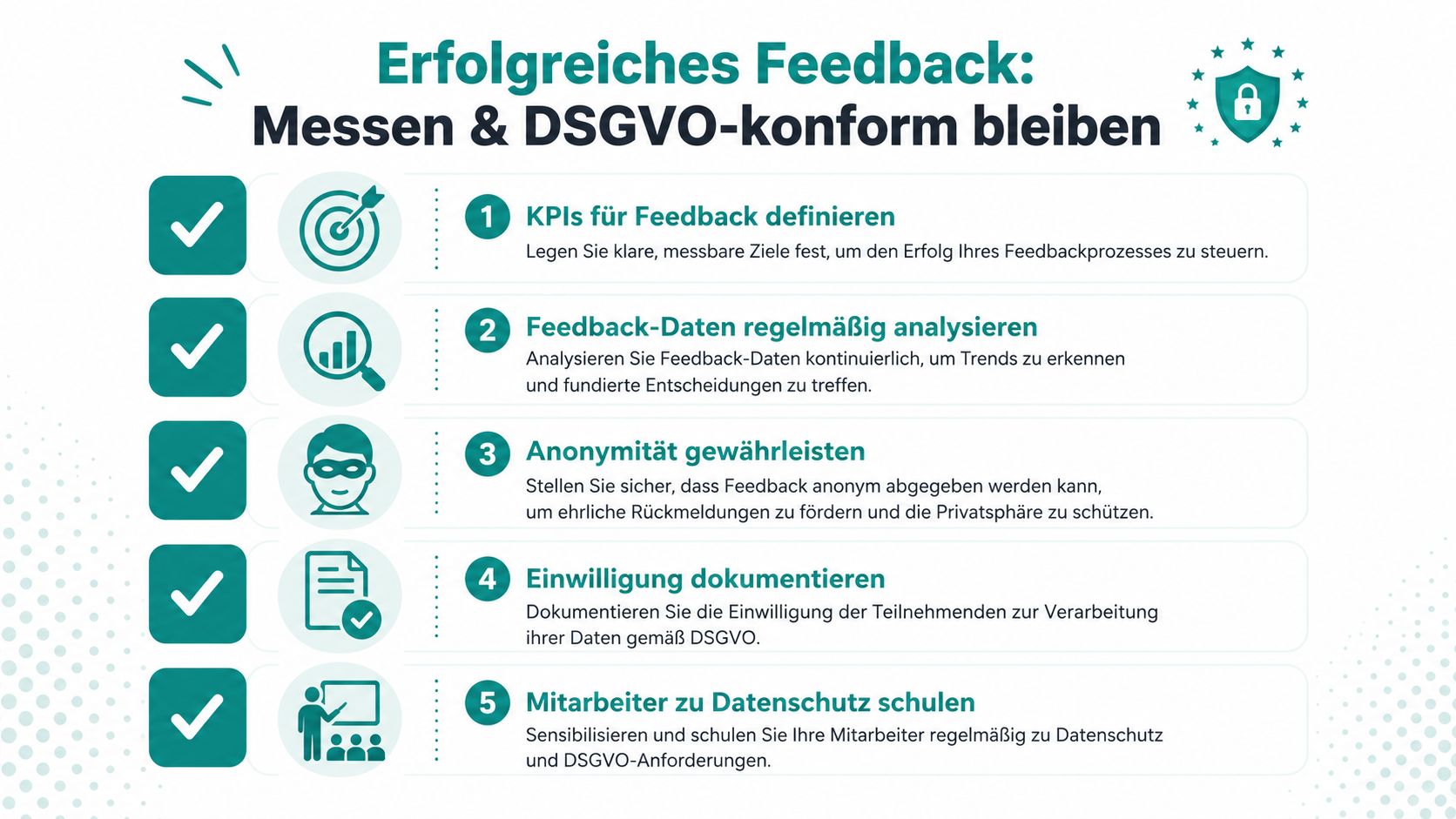
In Switzerland, the framework is clearly set by the revised Data Protection Act, revDSG. If feedback is personally identifiable or can be traced back to individual employees with little effort, a harmless survey quickly becomes a data protection problem. In small teams, this is especially sensitive. If you only deploy five hosts at one location or evaluate a security team with few staff, individual answers are often recognizable by writing style, shift, or incident.
Which Metrics Really Help in Operations
I would keep the set small. Too many metrics slow down evaluation, and in mobile operations, no one ends up looking at ten different reports.
Especially practical are these four perspectives:
- eNPS at fixed intervals. The value is quickly collected and shows whether the basic mood in a team improves or worsens. Qualtrics describes eNPS as a compact loyalty indicator that only becomes truly useful in connection with follow-up questions.
- Short free-text fields directly after the assignment. Here appear hints that make a difference in events, gastronomy, or security, such as missing material, unclear handovers, or too late briefings.
- Turnover by team, location, or assignment type. Not as a ranking for good or bad leadership but as an early warning signal.
- Rebooking rate and willingness to return. Especially in employee pools, this value often shows earlier than any survey whether people like to work for you again.
The level of evaluation is important. Those who look at individual shifts or mini-teams in isolation get a quick picture but risk misinterpretations and data protection problems. Better is the group view by location, role, client, or shift type. If you want to link such metrics cleanly with your pool, the article on performance tracking in your own employee pool helps because it clearly explains the difference between fair team management and personal control.
Setting Up Data Protection So the Team Joins In
Data protection rarely fails due to legal issues. It usually fails due to sloppy processes. A form is announced as anonymous, but the shift leader knows time, assignment, and wording. Then trust is gone.
These rules have proven themselves in practice:
- Only evaluate sufficiently large groups. A fixed minimum size prevents conclusions about individuals.
- Limit access. Clients, site managers, and dispatch don’t all need the same details.
- Define purpose in advance. Is it about assignment quality, leadership, briefings, or rebooking? Without clear purpose binding, every data collection is vulnerable.
- Define storage periods. Feedback from a past season does not need to remain in the system indefinitely.
- Document app processes. Who records feedback, who evaluates it, who may export it.
Clean organization helps in both areas. It makes feedback evaluable and data protection auditable. That is exactly why the look at optimized workforce planning in crafts fits. There the same operational principle emerges: When responsibilities, timings, and information paths are clear, friction and wrong decisions decrease even under pressure.
Trust arises when employees see that feedback leads to better briefings, more realistic handovers, and cleaner processes without singling out individuals.