
Hotel and Gastronomy Duty Roster: Planning and Regulations 2026
Optimize your hotel and gastronomy duty roster 2026. Learn how to assess demand, comply with laws, and control costs. With tips & tricks.
You’re sitting at the schedule for next week, the breakfast shift is still open, a group is arriving later than announced in the evening, and two employees have messaged you almost simultaneously. One needs time off, the other can only work until noon. This is exactly when a duty roster quickly shifts from “it’s fine” to constant stress.
In hotels and gastronomy, this is normal. The schedule rarely fails because of one big issue. It fails because of many small gaps: underestimated peak times, unclear availabilities, forgotten breaks, too much staff on a quiet Tuesday, and too few people on a Saturday evening. If you manage this properly, you achieve two goals at once. You keep costs under control and your team works more calmly.
A good duty roster for hotel and gastronomy is not a contradiction between saving money and fairness. It combines both. When you staff shifts appropriately, idle time and costly emergency solutions decrease. At the same time, your team gets more reliable assignments, predictable days off, and less chaos in daily work.
Table of Contents
- From Paper Chaos to Clear Duty Roster
- Laying the Foundation for Every Good Duty Roster
- Observing Legal Requirements in Switzerland
- Creating the Shift Schedule Step by Step
- Reacting Flexibly to Changes and Controlling Costs
- Taking the Next Step with Digital Tools
From Paper Chaos to Clear Duty Roster
Friday, 4:30 PM. In an hour, the restaurant fills up, two rooms are not yet released, a late group arrival is in the system at reception, and the first person is already asking for a swap in the team chat. It’s exactly in moments like these that you see whether a duty roster holds or just fills the week somehow.
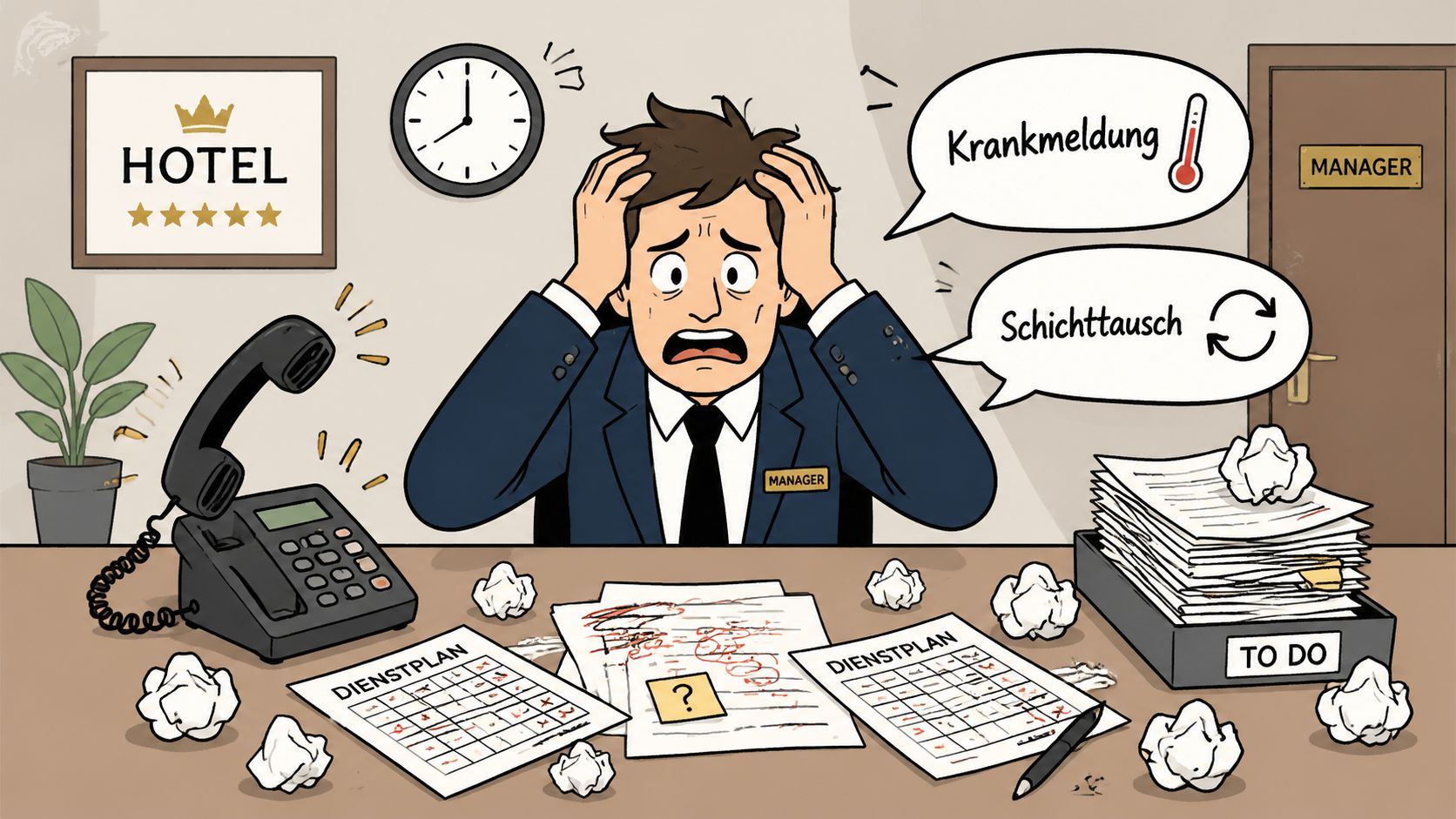
A good plan not only protects wage costs. It also protects the team. Those who regularly work understaffed make mistakes, become impatient with guests, and are more likely to call in sick. Those who constantly stand around during slow hours lose motivation just as much. Cost control and employee satisfaction are directly linked in operations.
Practical rule: If you fill the schedule just so every shift is somehow staffed, you pay twice. With unnecessary hours and with frustration in the team.
That’s why clean planning doesn’t start with names but with the question: Where is work really generated today, and when does it require which experience? A breakfast peak between 7 and 9 AM needs different people than a quiet afternoon with check-ins or an evening service with banquet and à la carte running in parallel.
In daily practice, this sequence has proven itself:
- Check workload first. Reservations, events, groups, arrivals, weather on the terrace, holiday weeks.
- Separate work by time windows. Breakfast, check-out, room releases, mise en place, evening service, bar, night.
- Set key positions first. Shift leaders, reception, kitchen, experienced service staff.
- Only accept changes with clear approval. No schedule changes by shout-outs, chat snippets, or handwritten corrections in three places.
The difference is immediately noticeable in operations. When enough experienced people cover the busy hours on Saturday evening, you need fewer hectic shifts, fewer overtime hours, and fewer after-hours disputes. This is exactly how a duty roster is created that is economically sound and accepted by the team.
Laying the Foundation for Every Good Duty Roster
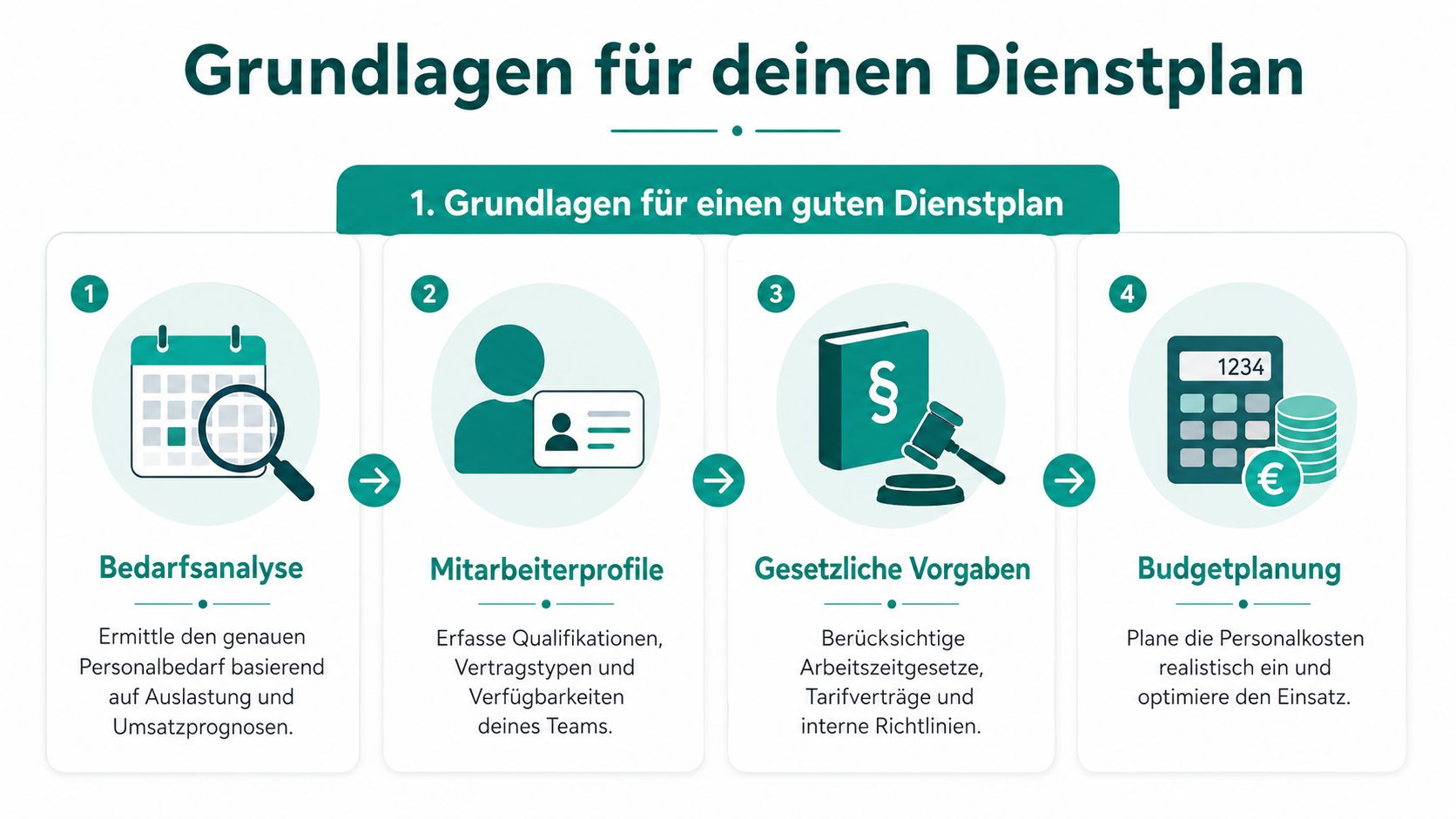
If you want to write a schedule that really holds, you don’t start with employees. You start with the operation. The most reliable method is simple: first guest forecast, then task analysis. This is exactly how duty scheduling in gastronomy is built step by step by first recording all regular tasks, then estimating the time required, and deriving the personnel needs from that (Zenchef on personnel planning in gastronomy).
First Read Guests and Occupancy
Don’t just look at the calendar. Look at the actual reason for work. In a hotel, Saturday may seem full even though the kitchen stays quiet in the evening. In a restaurant, Tuesday may look harmless until a large group occupies half the service.
These questions are needed every week:
- Which days have peak loads due to reservations, banquets, holidays, or vacation periods?
- Where do you have seasonal fluctuations? January is different from Christmas or summer holidays.
- Which areas are affected? More breakfast doesn’t automatically mean more bar staff.
A saying from everyday life fits well: You have to consider seasonal lows like January and peaks like Christmas, holiday periods, or large group bookings in planning. A sensible model is a core team of permanent employees that you supplement with temporary staff as needed (SumUp on creating a duty roster in gastronomy).
If you staff Christmas business with the January plan, both go wrong. In December you lack capacity. In January you pay for empty hours.
Then Break Down the Work into Areas
Now it gets concrete. Don’t just write “evening service 5 people.” Break down the assignment by tasks. Otherwise, you’ll end up missing exactly the person where experience counts.
An example from a restaurant with bar service on a Friday evening:
| Area | Typical Task | What You Need to Check |
|---|---|---|
| Reception | Seating guests, phone, walk-ins | Who stays calm even under pressure |
| Service | Managing stations, orders, upselling | Who knows the menu and procedures |
| Bar | Drinks, order flow, glasses, support service | Who works quickly and cleanly |
| Kitchen | Pass, production, cleanup | Who handles peaks without stress |
| Closing | Billing, cleaning, handover | Who takes responsibility |
With this view, you plan not “people on hours” but functions based on demand. This saves money because you staff more precisely. And it helps the team because no one is thrown into a shift for which they lack qualification or pace.
Practically, this means: Build your core team for fixed roles first. Then fill peaks with part-time or temporary help. In a Zurich restaurant, this might mean at Christmas: a broad evening and night shift with extra help. In quiet January, often a smaller early shift is enough. This thinking prevents you from overpaying one month and burning out your team the next.
Observing Legal Requirements in Switzerland
A duty roster that looks good on paper can still be wrong in daily operations. Not because staffing is bad, but because rest periods, breaks, or overtime were not properly checked. In Switzerland, the Working Hours Act and the L-GAV are not harassment. They set the framework for fair shifts.
If you take these rules seriously, there are two consequences. First, the risk of disputes over shifts, overtime, and too short breaks between two shifts decreases. Second, the schedule becomes more credible for your team. No one likes working in a company where rules only apply when convenient.
What You Must Check Before Each Release
Before posting, you need a fixed control round. Not by gut feeling, but the same way every time.
- Check rest periods. There must be no too short interval between two shifts.
- Actively include breaks. Breaks must not only exist theoretically.
- Make overtime visible. If someone is already accumulating hours, you need to counteract.
- Plan night and Sunday work consciously. Such shifts require proper management.
If you’re unsure how long a shift should be sensibly scheduled and how shift length affects workload and handovers, these details on shift duration help because they make the topic tangible from practice.
For Swiss companies, it’s also worth looking at the rules in the L-GAV for gastronomy so you don’t have to look them up only in case of conflict regarding working hours, rest periods, and overtime.
An unfair schedule is not only one with bad times. An unfair schedule is often one where rules are interpreted differently depending on the person.
How to Keep Rules in View Without Constant Stress
Manual checking is tedious. That’s exactly where mistakes happen. A tool can take a large part of this control work off your hands. According to Zenchef, the creation runs in three steps: employees enter availabilities via app, shift planning per work area, then assignment of shifts to available employees. The software also automatically checks compliance with L-GAV regulations and reports overtime or inconsistencies.
For you as a team leader, this practically means: You don’t have to keep every combination of late shift, early shift, and day off in your head. The system tells you where you need to look more closely. You still decide yourself. But you no longer decide blindly.
This helps enormously especially in smaller companies. Often there is no HR department in the background. The restaurant manager, front office manager, or head chef plans alongside daily business. The clearer the guardrails, the less trouble ends up on your desk later.
Creating the Shift Schedule Step by Step
Friday, 4:30 PM. The first guests are at check-in, the bar is filling up, early reservations arrive in the restaurant, and at 7 PM an event starts in the hall. Whether this evening runs smoothly or falls apart is often decided not in service but two weeks earlier at the duty roster.
A good plan combines two goals that are mistakenly separated in many companies. It keeps personnel costs under control and ensures the team can work fairly. Those who plan properly don’t save by understaffing. They save because overtime, idle time, and constant firefighting become rarer.
A Weekend Example from Hotel Daily Life
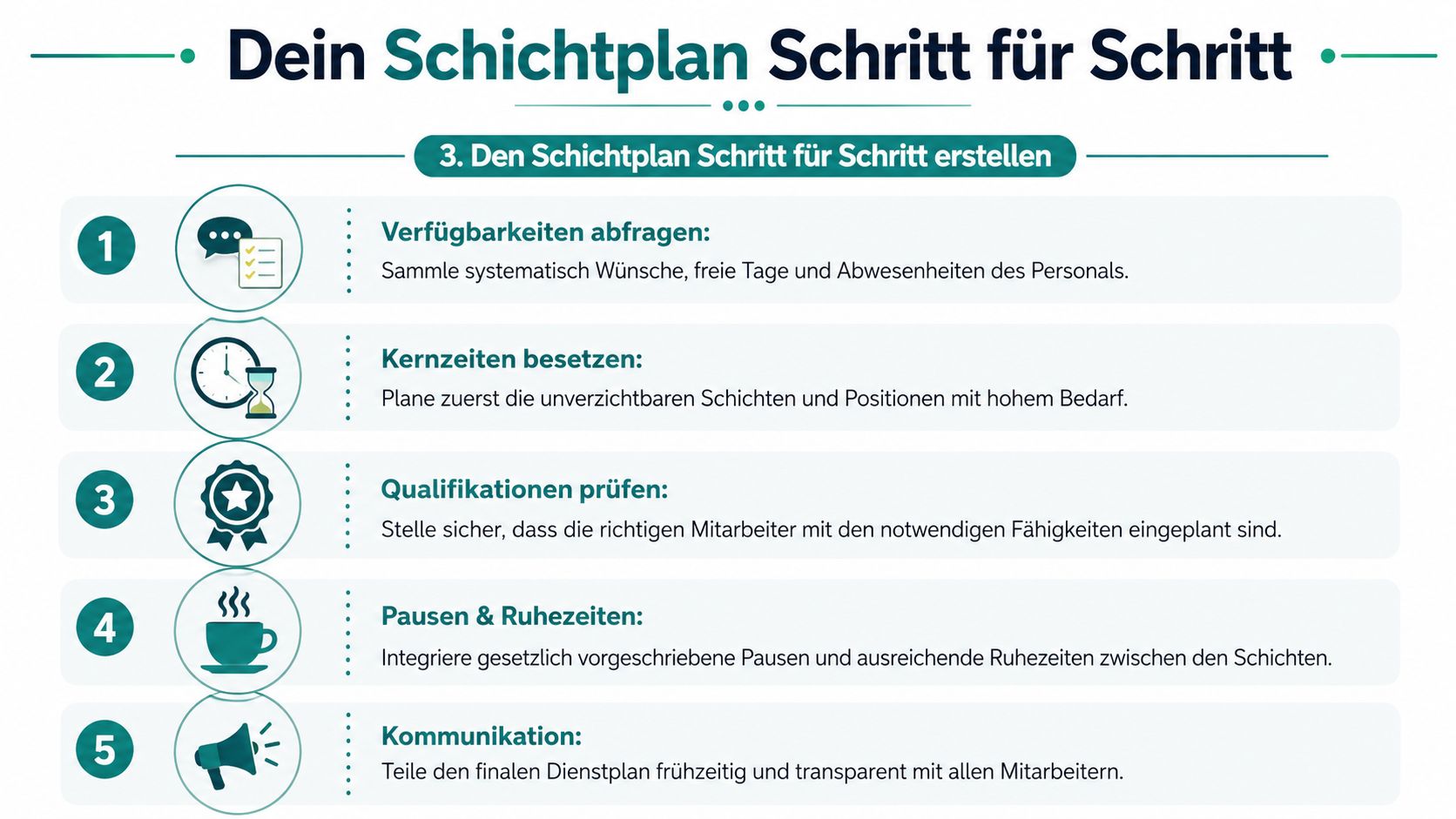
Take a city hotel with breakfast, housekeeping, and a small bar. Many guests arrive on Friday. Breakfast is full on Saturday morning. On Saturday evening, a private event takes place. In such a constellation, I always plan in this order:
-
Record availabilities bindingly
Time-off wishes, holidays, school, known doctor appointments, and already confirmed shifts must be on the table before the schedule. Not by shout-out and not scattered over WhatsApp. If you lack structure for this, use a work schedule Excel template for shifts and availabilities. -
Roughly outline workload per area
Reception needs fixed coverage at arrival times. Breakfast has a clear peak. Housekeeping depends on departures, arrivals, and turnover rooms. Bar and service rely more on evening business on Friday and Saturday. -
Staff key roles first
First assign people without whom the operation stalls. Shift leaders, front office, kitchen, service closing responsibility. Only then distribute additional staff. -
Secure peaks and handovers
Many schedules fail not during main times but during transitions. When the early shift is already gone and the late shift not fully started, waiting times, handover errors, and unnecessary stress occur.
How to Put Together Staffing Properly
The hospitality industry in Switzerland works with many small and medium teams. That’s exactly why the allocation must fit. One or two wrongly assigned shifts are often enough to cause overtime or service suffering.
A simple sequence helps with allocation:
-
Contracts and qualifications first
Who is allowed to take on what, who has leadership responsibility, who needs training, who is only available in certain time windows? -
Then fixed peak times
Breakfast from 6:30 to 10:00 AM, check-in wave in late afternoon, evening service, closing duties, event start, banquet breakdown. -
Only then flexible building blocks
Temporary help for the peak, floaters for absences, extra staff for groups or terrace.
An example from daily life: Three good service staff on Saturday evening sound strong on paper. But if none of them handles cash closing properly, takes complaints, or leads the team in the last third, it gets expensive. The evening drags on, the mood sours, and in the end, more hours are on the schedule than necessary.
This is exactly where cost control and employee satisfaction come together. A fairly distributed schedule prevents the same people from always carrying the tough closing shifts. At the same time, you avoid costly overstaffing during quiet hours. The team quickly notices whether someone thinks about workload or just fills gaps.
An economical duty roster is rarely the one with the fewest names. It’s the plan where staffing, qualification, and daily flow fit together.
Communicate the finished schedule early and in a fixed place. Preferably with clear version control. If employees guess every week which version applies, you lose time, trust, and often money in the end.
Reacting Flexibly to Changes and Controlling Costs
A published schedule is almost never final in hospitality. Someone gets sick. A bus group arrives earlier. The weather changes and the terrace stays empty. If you improvise anew every time, you lose money and nerves.
Better is a fixed process for changes. Not complicated. Just clear. Who accepts sick notes? Who may approve a swap? Who calls temporary staff? Who documents the change in the schedule? If this is not clarified, three people end up entering something and no one knows what really applies.
A Plan Is Just the Beginning
Especially small and medium businesses feel every misstaffing immediately. In Switzerland, there are only 32 companies larger than 250 employees in the gastronomy sector, showing how strongly the industry is shaped by small and medium teams. At the same time, consumer prices for restaurants and hotels rose by 2.1 percent in 2024 compared to the previous year (Statista on consumer prices and company sizes in Switzerland).
This means for your daily work: You cannot simply breathe away cost increases. Every unnecessary hour weighs more heavily. And every bad shift experience stays with the team.
Where You Lose Money in Daily Operations
The biggest losses often occur on perfectly normal days:
- Too many people too early
The restaurant opens quietly, but the schedule is still set to event mode. - Reacting too late
The afternoon stays weak, but full staffing continues. - No clean pool of temporary staff
The same person always jumps in when someone is absent. This makes the operation dependent and the team tired. - Hours not checked against reality
Planned is not the same as performed. You have to compare both continuously.
A simple example: Monday evening is emptier than expected. Then it’s often better to send part of the team home earlier instead of staffing fully until the end on suspicion. You have to handle this fairly and communicate clearly. If your team understands that you don’t cut arbitrarily but control according to the operation’s situation, it is more likely to be accepted.
Cost control and satisfaction come together exactly here. Those who cut blindly upset employees. Those who don’t control at all burn budget. The useful way lies in between: transparent, early, comprehensible.
Taking the Next Step with Digital Tools
At the latest when you collect availabilities from chats, holidays from emails, shift swaps by phone, and hours on paper, the schedule becomes unnecessarily heavy. Digital tools bundle exactly these parts in one place.
What Digital Planning Really Relieves in Daily Work
The advantage is not only that you type less. The real gain lies in the clean chain: enter availability, check demand, assign shifts, record times, track changes.
Automated duty scheduling can reduce planning effort by up to 80% and wage costs by up to 10%. Added to this are demand forecasts based on historical data as well as automatic checks of L-GAV and Working Hours Act, which reduce errors (Nostradamus on automated duty scheduling in hotels).
For a hotel or restaurant manager, this practically means:
- Employees enter availabilities themselves
- Shifts are planned by area
- Rule violations are detected before release
- Changes are visible to everyone
- Hours are cleanly prepared for payroll
One provider in this field is job.rocks for hotel duty scheduling. The platform bundles workforce planning, availabilities, mobile shift confirmations, and time tracking in one place. For businesses with temporary staff, event business, or multiple roles per location, this is often easier to manage daily than a mix of Excel, chat, and paper.
If you want to see how such a process looks in practice, a quick look at the video helps.
What You Should Look for When Choosing
Not every tool fits every business. A small restaurant needs something different than a hotel with reception, breakfast, banquet, and housekeeping. You don’t need the longest feature list. You need the points that really solve your chaos.
Pay attention to these questions:
| Feature | Why It Matters in Daily Work |
|---|---|
| Availabilities via app | You collect wishes and blackout times in one place |
| Roles and qualifications | Not every person fits every shift |
| Rule checking | Errors in rest periods and overtime are detected earlier |
| Shift swapping | The team can swap without you chasing every chat |
| Time tracking | Worked hours don’t stay on scraps of paper |
If you still plan manually today, you don’t have to switch everything at once. Start with availabilities and shift approvals. Then add time tracking and change logs. Even that removes much of the pressure that used to land on your desk every Friday or Sunday evening.
If you want to manage your hotel and gastronomy duty roster more cleanly, check out job.rocks. The platform connects availabilities, shift planning, mobile assignments, and time tracking in a workflow that fits especially well for hotels, restaurants, event gastronomy, and teams with temporary staff.